
Everyone’s building a personal brand. Everyone’s creating content. But content isn’t intellectual property. The brands that scale to nine figures aren’t built on content volume – they’re built on IP ownership. And there’s a fundamental difference most founders miss.
At unmtchd., we work at the intersection of fashion, sports, and culture, where we’ve observed that lasting brands don’t just create more – they own more. They build intellectual property that compounds in value, creates defensible positioning, and generates equity that transcends platforms and algorithms.
In this guide, we’ll break down what brand intellectual property actually means, why it’s become the cornerstone of modern brand building, and how to identify and develop your own. We’ll explore two types of IP that work together – tangible brand IP and human IP – and show you how to structure both into a scalable ecosystem.
What Is Brand IP? (And Why It’s Not What You Think)
Brand intellectual property (IP) refers to the unique frameworks, methodologies, and perspectives that differentiate your brand from competitors. Unlike content, brand IP is proprietary and legally protectable, creating defensible competitive advantages that compound in value over time.
Most founders confuse content creation with IP development. They’re not the same thing, and the distinction matters more than ever in an age where AI can generate endless content but cannot replicate lived experience, original thinking, or proprietary systems.
Content vs. Brand IP: Understanding the Difference
| Content | Intellectual Property |
| Daily posts, videos, articles | Frameworks, methodologies, systems |
| Abundant (AI can create it) | Scarce (requires lived experience) |
| Algorithm-dependent | Platform-independent |
| Viral but fleeting | Compounds in value over time |
| Output | Operating system |
| Tactic | Strategy |
| Anyone can copy tomorrow | Legally protectable and defensible |
The value proposition is straightforward: Content serves distribution. IP creates ownership. One is a tactic, the other is an asset.
Consider the difference between publishing “productivity tips” versus developing and trademarking a complete productivity methodology like David Allen’s “Getting Things Done®.” One piece of content might get shares and engagement. The other generates revenue through books, courses, licensing, and certification programs – decades after its creation. That’s the power of brand intellectual property.
Source: https://gettingthingsdone.com/what-is-gtd/
According to the World Intellectual Property Organization, intangible assets, including intellectual property, now constitute more than 90% of the total market value of S&P 500 companies. This isn’t a theoretical shift – it’s the reality of how value is created and measured in modern business.
The Two Types of Brand IP (And Why You Need Both)
At unmtchd, we’ve identified two distinct layers of proprietary brand assets that work together to create lasting brand equity. Understanding both is critical for founders building in the creator economy.
Tangible Brand IP – What You Can Protect and Scale
Tangible intellectual property consists of codified, structured assets that can be legally protected and scaled commercially. These are the elements you can trademark, copyright, patent, or protect as trade secrets.
This includes:
- Frameworks and methodologies – Named systems and processes you’ve created
- Visual identity – Logos, color palettes, typography systems
- Verbal identity – Brand names, taglines, proprietary language
- Products and services – Offerings with unique features or positioning
- Content with creative expression – Courses, books, templates, tools
- Processes and systems – Proprietary ways of working or delivering value
Legal protection mechanisms include:
| Protection Type | What It Covers | Duration | Example |
| Trademarks | Brand names, logos, slogans | 10 years (renewable indefinitely) | Nike swoosh, “Just Do It” |
| Copyrights | Creative works, original content | Life + 70 years | Course materials, books |
| Patents | Inventions, functional innovations | 20 years from filing | Product technology, processes |
| Trade Secrets | Confidential business information | Indefinite (while kept secret) | Coca-Cola formula |
The U.S. Patent and Trademark Office provides comprehensive resources on each protection type, but the strategic value of intellectual property extends far beyond legal filings.
Human IP – What Makes Your Brand Irreplaceable
Human IP represents the intangible elements rooted in lived experience, perspective, and authenticity that cannot be replicated. In an age where AI can generate content at scale, human IP has become the only truly scarce asset.
This includes:
- Origin story – The ‘why’ behind your brand’s existence
- Lived experiences – Unique background, career trajectory, formative moments
- Philosophical stance – Core beliefs and non-negotiables
- Cultural lens – How your background shapes your perspective
- Voice and personality – The authentic way you communicate
- Values and principles – What drives your decisions and priorities
Human IP matters because it’s fundamentally unreplicable. While competitors can copy your framework structure, they cannot copy the 20 years of experience at Disney, PUMA, and Warner Bros. that informed its creation. They cannot replicate your specific cultural context, your career pivots, or the unique combination of influences that shaped your thinking.
How They Work Together
Human IP drives authenticity → Brand IP drives longevity → Both create equity
The most powerful brands layer both types. Nike’s “Just Do It” philosophy (proprietary brand assets) gains credibility through partnerships with athletes like Serena Williams and LeBron James, who embody that ethos through their personal stories (human IP). Disney’s characters and story universes (intellectual property) were built on Walt Disney’s vision of family entertainment and imagination (human IP).
When you separate them, you get either soulless frameworks without authenticity or authentic stories without a scalable structure. Together, they create defensible, valuable brand equity.
When asked about her experience at Disney, Warner Bros, Paramount, and PUMA and the key difference she observed between brands that built lasting value versus those that chased trends, Oana, the founder of the unmtchd., says:
“The biggest difference was this:
Brands with lasting value are built on IP.
Brands chasing trends are built on moments.
“At Disney or Warner Bros., nothing was ever created for “the season.” Everything was built to live for decades. Mickey Mouse, Harry Potter, SpongeBob – these aren’t characters, they’re IP engines. They drive product, content, partnerships, experiences, and cultural presence year after year.
Contrast that with consumer brands that treated trends like strategy. A trend is a spark. IP is a system. Trend-led brands constantly had to “buy” attention. IP-led brands earned it.”
It didn’t matter whether I was working inside a film studio or inside a sportswear company – the lesson was the same:
When you build IP, you build equity.
When you chase trends, you burn energy.
The companies that won long-term understood one thing: IP is the only asset that compounds.”
Why Brand IP Is the Future of Brand Building
We’re witnessing a fundamental shift in how business value is created and measured. The evolution isn’t just about technology – it’s about what constitutes a competitive advantage in increasingly crowded markets.
The Evolution of Value in Business
| Era | Primary Value Driver | Measurement | Example |
| Industrial Age | Physical assets | Asset value, inventory | Factories, equipment, real estate |
| Information Age | Data & content volume | Traffic, reach, engagement | Databases, media libraries |
| Creator Economy | Intellectual property | Ownership, equity, defensibility | Frameworks, methodologies, ecosystems |
Research from the World Intellectual Property Organization shows that intangible assets – including intellectual property – now represent the overwhelming majority of corporate value. For S&P 500 companies, this figure exceeded 90% in 2023, compared to just 17% in 1975. The trajectory is clear: ownership of IP, not physical assets or even content volume, drives long-term value.
Why the Shift Is Accelerating Now
Several forces are converging to make brand intellectual property more critical than ever:
Content Abundance
Everyone can create content. AI accelerates this exponentially. When everyone can publish, create, and distribute at scale, content alone provides no competitive advantage. What matters is what you own that others cannot replicate.
Platform Volatility
Algorithm changes can destroy audience reach overnight. Building solely on social platforms means building on rented land. Instagram’s shift from chronological to algorithmic feed, Twitter’s transformation under new ownership, TikTok’s regulatory uncertainty – these aren’t anomalies. They’re the norm. Intellectual property lives independently of any platform.
Attention Scarcity
As content supply increases, attention becomes scarcer. Standing out through sheer content volume becomes prohibitively difficult. Brands need differentiation that goes deeper than posting frequency – they need IP that creates a distinct category position.
Ownership Economics
Investors and acquirers value what you own, not where you post. A million followers on a platform you don’t control is worth less than 10,000 people in a community you own, built around IP you’ve developed. One is a number that can disappear. The other is an asset with equity value.
The Competitive Moat Effect
Brand intellectual property creates defensibility that content cannot. According to Stripe’s analysis of business intellectual property, companies with protected IP achieve higher valuations and stronger market positions than those operating without proprietary assets.
Consider Method Products, the cleaning brand that disrupted a commodity category. Their distinctive bottle designs – protected as design IP – created immediate differentiation on retail shelves. Combined with their environmental philosophy and proprietary formulations, they built a brand that was eventually acquired for hundreds of millions despite competing in one of the most commoditized categories in consumer packaged goods.
Or consider Patagonia, where Yvon Chouinard’s philosophy of environmental stewardship (human IP) manifests in protected processes, certifications, and initiatives like their “Don’t Buy This Jacket” campaign. The brand’s IP extends beyond products to include their business model itself – structured to prioritize environmental impact over profit maximization. This creates both differentiation and defensibility in the outdoor apparel market.

Source: adweek.com
These aren’t accidents. They’re examples of strategic IP development creating competitive moats that content marketing alone could never build.
How Brand IP Works – Understanding the Layers
Brand intellectual property doesn’t exist as a single asset – it functions as interconnected layers that build on each other to create lasting brand value. Understanding these layers helps clarify where to focus your IP development efforts.
Layer 1: Human IP (The Foundation)
This is your unfair advantage – the raw material that AI cannot replicate and competitors cannot copy.
What it includes:
- Your unique story and background
- The experiences that shaped your perspective
- Your philosophical stance on the industry
- Your cultural context and influences
- Your authentic voice and communication style
Why it matters: Human IP is the source code. It’s where authentic differentiation begins. Without this foundation, brand intellectual property becomes a generic framework anyone could have created. With it, your methodologies carry the weight of lived experience that creates both credibility and inimitability.
Layer 2: Brand IP (The Structure)
This is where personal insight becomes scalable business value.
What it includes:
- Codified frameworks and methodologies with proprietary names
- Named systems and step-by-step processes
- Visual and verbal identity systems
- Product and service architecture
- Tools, templates, and application resources
- Legal IP protections
Why it matters: Brand intellectual property takes human insight and makes it teachable, scalable, and ownable. It’s the difference between being a skilled practitioner and owning a methodology others want to license. It transforms personal expertise into business assets that can generate revenue, attract investment, and compound in value over time.
Layer 3: Ecosystem IP (The Multiplier)
This is how one core IP becomes infinite value—the model that Disney perfected and that modern creators are now applying.
What it includes:
- Multiple format expressions (content, products, experiences, certifications)
- Community and platform ownership
- Partnership and licensing opportunities
- Multiple revenue streams from one core IP
- Interconnected brand touchpoints that reinforce each other
Why it matters: Ecosystem IP is how brands scale without losing coherence. One framework becomes a book, course, certification program, community, consulting practice, and software tool. Each expression reinforces the others, creating a flywheel effect where the ecosystem itself becomes more valuable than any individual component.
Real Example: How Disney Built Layered IP
Human IP: Walt Disney’s vision of family entertainment, his belief in imagination and storytelling, his experiences creating animation
Brand IP: Mickey Mouse character (trademarked globally), animation techniques (patented), distinctive visual style (copyrighted), theme park design systems, storytelling formats
Ecosystem IP: Animated films, live-action movies, Disney+, theme parks across multiple continents, Broadway shows, cruise lines, merchandise, licensing partnerships – all interconnected through shared characters and story universes
Disney didn’t build products. They built IP systems that could express across any medium. A character introduced in a film becomes a theme park attraction, merchandise line, Broadway show, and streaming content. The IP is the asset; the formats are expressions of that asset.
This model isn’t exclusive to entertainment conglomerates. Modern creators and brands are applying the same layered structure: foundational human authenticity, structured brand frameworks, and expanded ecosystem expressions.
Oana says:
“The clearest example of this is working on PUMA’s athlete storytelling ecosystem – especially during the Usain Bolt era.
You had three IP layers working together:
1. Human IP – the athlete’s story
Bolt wasn’t just fast. He was joy, charisma, ease, confidence. His personality became an asset. His wins became global cultural moments. You cannot manufacture that – you can only recognize it and build around it.
2. Brand IP – product innovation
PUMA didn’t just give him spikes. They built innovation narratives around speed, lightness, and performance. The products weren’t accessories to the story – they were extensions of it.
3. Ecosystem IP – partnerships & culture
Bolt wasn’t activated in isolation.
Every touchpoint worked together:
- campaign storylines
- retail experiences
- apparel collections
- global events
- youth programmes
- entertainment crossovers
It created a loop:
Bolt made the brand feel alive.
The brand made his story go further.
Partnerships amplified both.
That’s what true IP stacking looks like – not a campaign, but an ecosystem.
And this isn’t just a sports example. The same pattern exists in every lasting brand.”
The unmtchd.™ IP Stack: Our Brand Strategy Framework
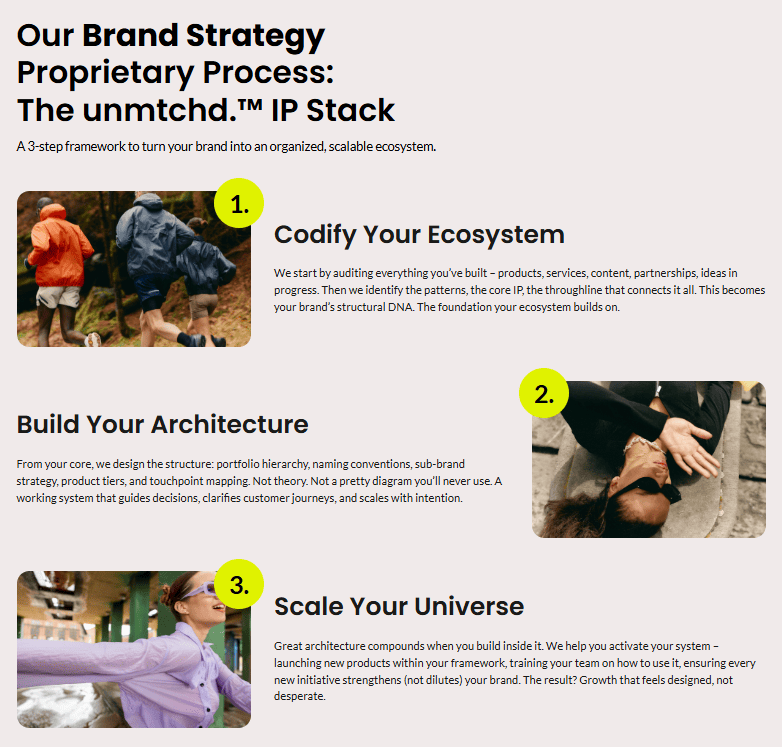
While understanding the conceptual layers of IP is important, actually building brand intellectual property requires a systematic process. At unmtchd, we’ve developed a proprietary 3-step framework for turning brands into revenue-driving ecosystems: The unmtchd.™ IP Stack.
Step 1: Codify the IP
We start by extracting what makes your brand unmatched: your story, strengths, philosophy, and unique assets. This includes identifying both human IP (your lived experience and perspective) and brand IP (frameworks, trademarks, methodologies).
What happens in this step:
- Deep brand audit to identify existing IP (often hidden in plain sight)
- Documentation of your origin story and unique positioning
- Codification of your methodology into named, ownable frameworks
- Assessment of what requires legal protection (trademarks, copyrights)
- Organization of IP into a clear, structured hierarchy
The outcome: A comprehensive IP foundation that forms the basis of your brand identity and all future growth. You know what you own, what makes you different, and how to articulate it.
Step 2: Build the Ecosystem
From content and products to partnerships and platforms, we help you connect your IP across touchpoints. This is where strategic brand architecture transforms single offerings into interconnected systems.
What happens in this step:
- Map how core IP can express across multiple formats
- Design product and service architecture around your IP
- Identify partnership and collaboration opportunities that extend your reach
- Create content strategy that demonstrates (not just describes) your IP
- Build owned platforms and community spaces
- Develop licensing or certification pathways where relevant
The outcome: A dynamic, interconnected brand universe that delivers value at every layer. Your IP isn’t locked in one product – it flows through multiple expressions that reinforce each other and build long-term relevance.
Step 3: Scale and Amplify
We craft strategies that scale your brand’s impact through strategic positioning, channel alignment, and storytelling that resonates. The focus is on growing brand equity, attracting aligned audiences, and driving sustainable momentum.
What happens in this step:
- Develop a go-to-market strategy for your IP-led brand ecosystem
- Create positioning and messaging that cuts through market noise
- Design a channel strategy that maximizes reach without diluting the brand
- Build partnerships and collaborations that amplify your IP
- Implement systems for ongoing IP development and protection
- Establish metrics that track brand equity (not just vanity metrics)
The outcome: Scalable growth rooted in ownership. As your brand expands, your IP becomes more valuable – not diluted. You’re building equity that compounds over time.
Why This Framework Works
The unmtchd.™ IP Stack works because it addresses the complete journey from identification to implementation to scaling. Most brands either:
- Never codify what makes them unique (stuck in generic positioning)
- Codify but never build an ecosystem (one-dimensional offerings)
- Build an ecosystem without a strategy (disconnected, confusing brand)
Our framework ensures all three elements work together: clear IP + connected ecosystem + strategic amplification = sustainable brand equity.
This is the methodology we teach inside the unmtchd. Collective and implement through our advisory services. Whether you’re a founder just defining your brand or an established company looking to strengthen your IP position, this framework provides the structure for building ownership-based brand value.
The Role of IP in Different Industries
Brand IP strategy manifests differently across sectors, but the underlying principle remains consistent: successful brands layer human authenticity with scalable, protectable IP.
| Industry | Primary IP Focus | Real Example |
| Fashion | Design IP, brand heritage, visual identity, signature aesthetics | Chanel’s interlocking C logo (trademarked), distinctive tweed fabric patterns, signature quilted bag design |
| Sports | Performance innovation, athlete partnerships, training methodologies | Nike’s Flyknit technology (patented), Jordan brand partnership structure, proprietary cushioning systems |
| Technology | Patents, proprietary algorithms, user experience design | Apple’s iOS ecosystem, multi-touch interface patents, distinctive product design language |
| Entertainment | Character IP, story universes, content formats | Marvel Cinematic Universe interconnected storylines, character licensing across media |
| Consumer Goods | Trade secrets, brand equity, packaging innovation | Coca-Cola’s beverage formula (trade secret), Method’s distinctive bottle designs (design patents) |
| Education | Frameworks, certification systems, proprietary methodologies | Montessori Method (trademarked approach), various test prep systems |
The pattern across successful brands: they don’t rely on a single IP type. They build layered protection and value through multiple IP categories working together. A technology company doesn’t just patent inventions – they also trademark brand elements, copyright software code, and protect trade secrets around their processes.
How to Identify Your Brand’s IP
Most founders already possess more intellectual property than they realize. The challenge isn’t creation from scratch – it’s recognition and codification of what already exists.
Step 1: Audit Your Existing Assets
Start by examining patterns in your work and expertise:
Questions to ask yourself:
- What do clients, customers, or followers consistently ask you about?
- What themes repeat across your content, products, or services?
- What’s your unique perspective or approach to your industry?
- What processes have you developed that others don’t use?
- What makes your methodology different from competitors?
- What aspects of your background inform your work in distinctive ways?
Document everything. Patterns reveal IP opportunities.
Step 2: Distinguish Content from IP
Not everything you create qualifies as intellectual property. Use this framework to evaluate:
| Evaluation Question | Content | IP |
| Can AI replicate this? | Yes | No |
| Does it require my specific lived experience? | Sometimes | Yes |
| Is it ownable or protectable? | No | Yes |
| Does it compound in value over time? | No | Yes |
| Can it generate multiple revenue streams? | Limited | Yes |
| Would this work without my name attached? | Often yes | Should be no |
If something passes the IP tests, it deserves strategic development and potentially legal protection. If it’s content, it serves distribution but shouldn’t be confused with core assets.
Step 3: Map Your Human IP
This is the foundation everything else builds on. Document systematically:
Your origin story:
- Why you do what you do (not just what you do)
- The moment or experience that catalyzed your current work
- The gap you saw that nobody else was addressing
Formative experiences:
- Career pivots and what triggered them
- Failures or setbacks that shaped your approach
- Mentors, influences, or opposing viewpoints that refined your thinking
Unique perspectives:
- What you believe that’s non-negotiable in your field
- Where you disagree with industry consensus (and why)
- The intersection of influences that only you occupy
Cultural context:
- Geographic, educational, or industry background
- Multiple sectors or disciplines you bridge
- Languages, cultures, or communities that inform your lens
This becomes your unfair advantage – the context that makes your frameworks different from everyone else’s “5 steps to [outcome].”
Step 4: Codify Your Brand IP
Transform insights into ownable assets:
Name your methodology:
Generic: “My approach to brand strategy”
Proprietary: “The IP Stack™” or “The Brand Ecosystem Blueprint”
Proprietary language creates ownership. If your framework has a name, people can reference it, remember it, and attribute it to you.
Document your framework:
- Break your approach into clear, teachable steps
- Create visual representations (diagrams, models, infographics)
- Develop application tools (worksheets, templates, assessment tools)
- Write the definitive explanation of how it works
Consider legal protection:
- Trademark your methodology name
- Copyright your written explanations and visual representations
- Use proprietary language consistently across all platforms
- Consult an IP attorney for comprehensive strategy
Step 5: Design Your Ecosystem
Map how your core IP can expand across multiple expressions:
Multiple formats: Core framework → Blog content → Online course → Book → Certification program → Software tool
Multiple audiences: Individual practitioners (B2C) → Companies (B2B) → Licensed trainers → Enterprise partnerships
Multiple touchpoints: Digital products → Physical products → Live experiences → Community platform → Consulting services
Multiple revenue streams: Direct sales → Subscription revenue → Licensing fees → Partnership income → Certification programs
The goal isn’t to build everything immediately – it’s to design with ecosystem thinking from the start. When you develop your first product or framework, you’re not just creating that one thing. You’re creating the seed of a system that can grow across multiple expressions over time.
Real Example: Notion’s IP Evolution
Notion provides a clear case study of IP development and ecosystem thinking:
Initial Brand IP: Flexible database system with modular building blocks (proprietary software architecture)
Ecosystem expansion:
- Community-created templates (extended value without direct creation)
- Consultant and agency network (human IP leverage through partners)
- API for developers (platform IP that others build on)
- Certification program (scaled expertise validation)
- Enterprise solutions (same IP, different audience)
Source: https://www.notion.com/
They didn’t launch with all of this. They started with core IP (the flexible database concept and execution) and systematically expanded the ecosystem. The IP remained consistent; the expressions multiplied.
Common Mistakes When Building Brand IP
We’ve observed patterns in how founders approach (or avoid) IP development. Understanding these mistakes helps you sidestep them.
Mistake #1: Confusing Presence with Ownership
The trap: Building large audiences on social platforms while developing no owned assets
The reality: Followers on rented platforms can disappear with algorithm changes, policy shifts, or platform decline. You control nothing.
The solution: Own your distribution (email lists, your website) and own your IP (frameworks, methodologies, content that lives on your platforms). Use social media for discovery, but convert attention to owned assets.
Mistake #2: Creating Content Without Strategic IP
The trap: Publishing daily content without ever codifying your unique methodology or perspective
The reality: You’re on a content treadmill – constantly creating but never building equity. Volume doesn’t equal value. When you stop posting, value stops accruing.
The solution: Extract patterns from your content. Identify the frameworks you use repeatedly. Name them. Codify them. Build the IP first, then create content that demonstrates and distributes it.
Mistake #3: Undervaluing Human IP
The trap: Sharing generic best practices and industry wisdom without connecting it to your unique experience
The reality: Anyone can say “be authentic” or “focus on your customer.” That’s not IP – it’s common knowledge. What’s YOUR specific path? What did YOU learn that others don’t know?
The solution: Lead with lived experience, not borrowed wisdom. Your story, failures, pivots, and hard-won insights are the foundation of defensible IP. The framework matters less than the experience that created it.
Mistake #4: Skipping Legal Protection
The trap: Assuming your work is automatically protected or that “nobody would steal it”
The reality: Without trademarks, copyrights, or other legal protections, you have limited recourse when others use your IP. You also can’t license, sell, or leverage it as a business asset.
The solution: Consult with an IP attorney early. Trademark your brand name and key methodology names. Copyright your frameworks and creative works. Use NDAs when sharing proprietary information. Document everything. Legal protection isn’t paranoia – it’s strategic asset development.
The U.S. Patent and Trademark Office offers resources on protection mechanisms, but professional legal counsel ensures your specific IP receives appropriate protection.
Mistake #5: Building in Isolation (No Ecosystem Thinking)
The trap: Creating one product, one format, one revenue stream without considering how IP could expand
The reality: True value comes from IP that scales across multiple expressions. A single course has limited value. A methodology that powers a course, book, certification, community, and consulting practice has exponential value.
The solution: Design for the ecosystem from day one. Even if you start with one expression (a workshop, for example), architect it so the core IP can expand into other formats. Build the connective tissue between offerings rather than treating each as isolated.
On the most common mistake founders make when it comes to brand IP, Oana says:
“The biggest mistake is this:
They think IP is legal paperwork or a trademark.
It’s not. IP starts long before the lawyers come in.
Founders often jump into logos, names, and aesthetics, but they skip the foundational IP questions:
- What meaning are you building?
- What problem are you owning?
- What rituals or behaviours do you want to shape?
- Why does this brand deserve to exist long-term?
My advice is simple:
Treat your IP as the backbone, not the byproduct.
Your Human IP is who you are and what you uniquely bring.
Your Brand IP is the value you deliver and how you express it.
Your Ecosystem IP is how your idea expands into products, community, partnerships, content, and experiences.
If founders started here, they wouldn’t have “a brand.” They would have an asset that can scale, without them burning out or constantly reinventing.
IP is not a step in the process.
It is the strategy.”
Frequently Asked Questions About Brand IP
What does IP stand for in branding?
IP stands for Intellectual Property. In branding, it encompasses the unique frameworks, methodologies, stories, and perspectives that differentiate your brand from competitors. Unlike physical assets, proprietary brand assets are intangible but often represent the majority of a company’s value – particularly in the creator economy and knowledge-based industries.
What is an example of an IP brand?
Disney exemplifies brand IP at scale. Their intellectual property portfolio includes trademarked characters (Mickey Mouse, Marvel heroes, Star Wars properties), copyrighted films and shows, patented theme park technologies, and protected entertainment formats. This IP generates revenue across movies, streaming platforms (Disney+), theme parks on multiple continents, merchandise, licensing deals, and theatrical productions. One piece of IP – a character like Elsa from Frozen – becomes a multi-billion dollar ecosystem spanning films, sequels, merchandise, theme park attractions, Broadway shows, and streaming content. That’s the power of strategic IP development.
What does IP stand for in products?
In products, IP refers to proprietary innovations, designs, formulas, or technologies that are legally protected. This includes:
- Utility patents for functional innovations (how something works)
- Design patents for aesthetic features (how something looks)
- Trademarks for product names, logos, and brand identifiers
- Trade secrets for confidential processes or formulas
For example, Apple protects their product designs through design patents, their iOS software through copyright, their brand name and logo through trademarks, and certain manufacturing processes as trade secrets. This layered IP protection creates multiple defensive barriers around their products.
What are the types of intellectual property relevant to brands?
Four primary types of IP protect different aspects of brands:
| IP Type | Protects | Protection Duration | Brand Example |
| Trademarks | Brand names, logos, slogans, distinctive colors/sounds | 10 years, renewable indefinitely | Nike swoosh, Tiffany blue color, “Just Do It” slogan |
| Copyrights | Original creative works, content, written materials | Creator’s life + 70 years | Course materials, books, marketing content, photographs |
| Patents | Inventions, innovations, functional designs | 20 years from filing date | Product technology, manufacturing processes |
| Trade Secrets | Confidential business information, formulas | Indefinite (while maintained as secret) | Coca-Cola formula, customer databases, algorithms |
At unmtchd, we add two additional categories that matter for modern brand building:
- Human IP: Your story, lived experience, unique perspective
- Ecosystem IP: How all your IP connects and reinforces across multiple platforms
What’s the difference between IP and trademark?
Intellectual Property (IP) is the umbrella term covering all intangible creative assets. A trademark is one specific type of IP that protects brand identifiers – names, logos, slogans, and sometimes distinctive colors, sounds, or packaging.
Think of it hierarchically:
- IP = The category (all intangible property)
- Trademarks (brand identifiers)
- Copyrights (creative works)
- Patents (inventions)
- Trade secrets (confidential information)
A brand typically uses multiple IP types simultaneously. Nike owns trademarks (swoosh, “Just Do It”), copyrights (ad campaigns, content), patents (shoe technology like Air cushioning), and trade secrets (manufacturing processes). Together, these create comprehensive IP protection.
How to protect brand IP assets?
IP protection requires both strategic and legal approaches:
Strategic protection:
- Document your methodologies – Write down your frameworks, processes, and unique approaches
- Use proprietary language – Name your systems with distinctive, trademarkable names
- Build on owned platforms – Your website, email list, and independent platforms you control
- Create defensible positioning – Develop unique points of view that can’t be easily replicated
- Maintain confidentiality – Use NDAs when sharing sensitive information with employees, contractors, or partners
Legal protection:
- Trademark registration – File for your brand name, logo, and key methodology names
- Copyright registration – Register your creative works, courses, and substantial written content
- Patent filing – If you’ve invented something novel, file for utility or design patents
- Trade secret protocols – Implement systems to keep confidential information actually confidential
- Legal counsel – Work with an IP attorney to develop comprehensive protection strategy
The U.S. Patent and Trademark Office provides filing resources, but professional legal guidance ensures you’re protecting what matters most for your specific business.
For strategic IP development and brand architecture that integrates ownership thinking, unmtchd’s advisory services help founders develop comprehensive IP strategies from the ground up.
What are the risks of not protecting brand intellectual property?
Operating without IP protection creates several significant vulnerabilities:
| Risk Category | Impact | Example Scenario |
| Competitive copying | Competitors replicate your frameworks | Your “5-Step Method” gets copied by 20 others; you can’t stop them |
| Lost revenue | Cannot monetize through licensing | A company wants to license your methodology but you have no legal IP to license |
| Weak market position | Cannot defend your uniqueness | Multiple people claim the same framework; you can’t prove it’s yours |
| Lower valuation | Investors see nothing proprietary | During fundraising, investors find no defensible IP in your business |
| No legal recourse | Cannot enforce rights or stop infringement | Someone publishes your framework as their own; you have no legal standing |
| Brand dilution | Others use your name, concepts, or methodology | Your brand identity becomes generic; market confuses you with imitators |
| Platform dependency | Building on rented land with no owned assets | Platform algorithm change destroys your business overnight |
Research from the World Intellectual Property Organization demonstrates clear correlation between IP protection and company valuations. Businesses with protected IP portfolios consistently achieve higher valuations and stronger market positions than competitors operating without proprietary assets.
The risk isn’t just about others stealing your ideas – it’s about building a business with no defensible equity. Without IP, you have a job, not a sellable asset.
From Content Creator to IP Owner – The Mindset Shift
The creator economy is maturing. Early-stage creators focus on content volume and platform growth. Sophisticated creators focus on IP ownership and ecosystem development. The difference determines whether you build a job or build equity.
The Old Model: Content as Currency
The traditional creator playbook:
- Post content frequently across platforms
- Chase engagement metrics (likes, shares, comments)
- Build an audience on social platforms
- Remain dependent on algorithms for distribution
- Hope for viral moments that boost visibility
- Monetize through brand deals and sponsorships
This model worked when platforms rewarded reach and when creator supply was lower than demand. It’s increasingly ineffective as platforms prioritize their own content (TikTok Shop, Instagram Reels ads) and as AI floods channels with generated content.
The New Model: Brand Intellectual Property as Equity
The ownership-based approach:
| Content-First Approach | IP-First Approach |
| “I need to post daily” | “I need to document my unique methodology” |
| “How do I go viral?” | “What do I own that competitors don’t?” |
| “More followers = success” | “Ownable assets = business value” |
| “What’s trending in my niche?” | “What’s my distinct perspective?” |
| Algorithm-dependent distribution | Algorithm-resistant equity |
| Platform loyalty | Platform independence |
| Sponsored content revenue | Licensing and ecosystem revenue |
The Integration: Content Serves IP
Content and IP aren’t mutually exclusive – they’re complementary when structured correctly. The most effective strategy uses content to demonstrate and distribute IP, not as an end in itself.
The model: Develop proprietary intellectual property → Create content that showcases the IP → Convert audience to owned platforms → Monetize the IP through multiple streams
Real example of the transition:
James Clear (author of “Atomic Habits”) provides a clear case study:
- Initial phase: Published blog content testing ideas about habit formation
- IP codification: Synthesized patterns into proprietary framework
- IP protection: Published book (copyright), trademarked “Atomic Habits”
- Ecosystem expansion: Built newsletter list, created course, developed community
- IP licensing: Methodology taught by certified coaches, framework referenced in corporate training
The content didn’t become the business – it became distribution for the IP. The IP became the asset. Clear owns something that generates value independent of any social platform, immune to algorithm changes, and sellable as a business asset.
Building Your Brand IP Strategy
Whether you’re a founder building your first product, a creator developing your methodology, or a brand leader scaling an existing business, IP strategy should be central to your growth plan – not an afterthought.
Where to Start: Assess Your Current Position
Before building a brand IP strategy, understand what you already have:
Audit questions:
- What frameworks or processes do you use that you’ve never formally documented?
- What do clients or customers say you’re uniquely good at?
- What patterns exist across your work that you’ve never named?
- What protection do you already have in place (trademarks, copyrights)?
- Where are you most vulnerable to competitive copying?
Most founders discover they have more IP than they realized – it just hasn’t been identified, named, or protected.
Prioritize Based on Your Stage
For early-stage founders:
- Focus area: Human IP documentation and initial proprietary brand assets codification
- Action steps: Document your origin story and unique perspective. Codify one core framework that represents your methodology. Protect your brand name through trademark.
- Investment level: Modest – focus on strategic development before extensive legal protection
For scaling brands:
- Focus area: Comprehensive IP audit and ecosystem design
- Action steps: Inventory all existing IP assets. Strengthen legal protections for key assets. Map how core IP can expand across multiple formats and audiences. Begin licensing conversations.
- Investment level: Moderate to significant – balance legal protection with ecosystem development
For established brands:
- Focus area: IP portfolio optimization and monetization
- Action steps: Conduct professional IP valuation. Evaluate which assets drive most value. Develop sophisticated licensing and partnership structures. Consider IP as standalone business unit.
- Investment level: Significant – treat IP as major strategic asset requiring dedicated resources
Get Expert Support
Building a brand IP strategy requires specialized expertise at different stages:
When to involve an IP attorney:
- Before publicly launching any named framework or methodology
- When you’ve developed something potentially patentable
- If you’re entering licensing or partnership agreements
- When you discover infringement of your work
- During fundraising or acquisition conversations (IP due diligence)
When to involve a brand strategist:
- When developing your positioning and unique market space
- For a comprehensive brand architecture that includes an IP strategy
- When designing ecosystem expansion from the core IP
- During rebranding or repositioning initiatives
At unmtchd, we work with founders and brand leaders on comprehensive brand architecture that integrates IP thinking from the foundation. Our advisory services guide you through identifying, codifying, and scaling your brand IP as part of a holistic business strategy – not as a separate legal consideration.
Build Community and Ecosystem
Brand intellectual property gains value through application and community. The most successful IP-led brands create environments where the IP is used, taught, and expanded:
Consider these ecosystem elements:
- Education: Teaching your methodology through courses, workshops, or certification
- Community: Building platforms where people apply your frameworks together
- Multiple expressions: Creating diverse ways to engage with your IP (products, services, content, tools)
- Partnerships: Collaborating with others who embody or extend your IP
- Licensing: Allowing others to use your frameworks with proper attribution and compensation
Inside The unmtchd. Collective, we explore IP development alongside founders and brand leaders who are building ownership-based businesses – not just content-based audiences. The community provides accountability, feedback, and strategic guidance as you develop your brand IP and scale it into comprehensive ecosystems.
The Future Is Ownership
Brand IP represents the strategic foundation of lasting business value. While content creates visibility, IP creates ownership. While trends generate attention, IP generates equity.
The brands that will define the next decade won’t be those with the most followers – they’ll be those with the most defensible intellectual property. They’ll own frameworks competitors can’t copy, perspectives that can’t be replicated by AI, and ecosystems that create compound value over time.
The Two-Part Foundation
Every successful IP strategy builds on this foundation:
Human IP: Your story, lived experience, and authentic perspective that provides the raw material for differentiation
Brand IP: The frameworks, systems, and assets you build from that foundation that can be protected, scaled, and monetized
Together, these create brand equity that transcends platforms, algorithms, and market trends. They create value that compounds rather than depletes. They transform personal expertise into transferable business assets.
What’s Next
Whether you’re a founder building your first product, a creator developing your methodology, or a brand leader scaling an existing business, IP strategy should be central – not peripheral – to your growth plan.
The question isn’t whether to build IP. In an age of content abundance and AI-generated everything, ownable intellectual property is the only sustainable competitive advantage. The question is how deliberately and strategically you’ll develop it.
Take the next step:
- Need strategic guidance on your brand IP? Our advisory services help founders develop comprehensive IP strategies and brand architecture that integrates ownership thinking from the foundation.
- Want to build alongside other founders? Join The unmtchd. Collective – our private community for brand leaders building IP-led businesses, not just content-based audiences.
The future of brand building is ownership. And ownership starts with intellectual property.